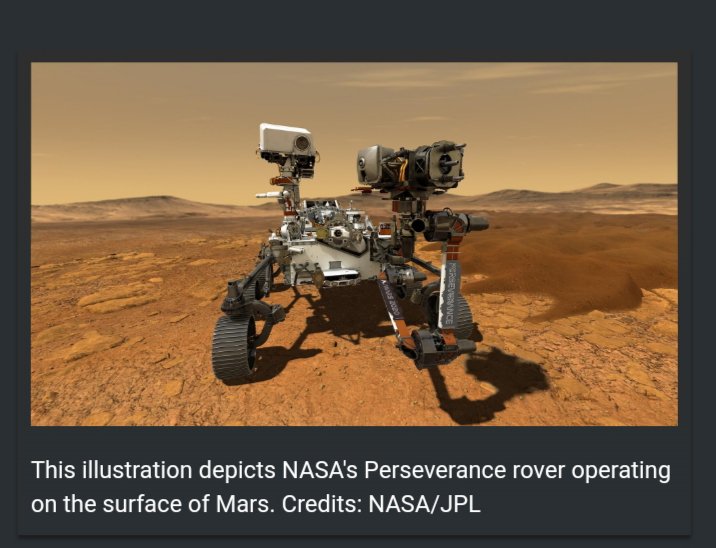
The Mars 2020 Perseverance Rover will search for signs of ancient microbial life, which will advance NASA’s quest to explore the past habitability of Mars. The rover has a drill to collect core samples of Martian rock and soil, then store them in sealed tubes for pickup by a future mission that would ferry them back to Earth for detailed analysis. Perseverance will also test technologies to help pave the way for future human exploration of Mars.
Strapped to the rover’s belly for the journey to Mars is a technology demonstration — the Mars Helicopter, Ingenuity, may achieve a “Wright Brothers moment “ by testing the first powered flight on the Red Planet.
Searching for Ancient Life, Gathering Rocks and Soil
There are several ways that the mission helps pave the way for future human expeditions to Mars and demonstrates technologies that may be used in those endeavors. These include testing a method for producing oxygen from the Martian atmosphere, identifying other resources (such as subsurface water), improving landing techniques, and characterizing weather, dust, and other potential environmental conditions that could affect future astronauts living and working on Mars.
Key Facts
Launched: July 30, 2020 at 4:50 a.m. PDT (7:50 a.m. EDT)
Landed: Feb. 18, 2021 at 12:55 p.m. PST (3:55 p.m.EDT)
Mission Duration: At least one Mars year (about 687 Earth days)
Mars 2020 Perseverance Rover Science:
Studying Mars’ Habitability, Seeking Signs of Past Microbial Life, Collecting and Caching Samples, and Preparing for Future Human Missions
The Perseverance rover has four science objectives that support the Mars Exploration Program’s science goals:Looking for Habitability: Identify past environments capable of supporting microbial life.
Seeking Biosignatures: Seek signs of possible past microbial life in those habitable environments, particularly in special rocks known to preserve signs of life over time.
Caching Samples: Collect core rock and “soil” samples and store them on the Martian surface.
Preparing for Humans: Test oxygen production from the Martian atmosphere.
All address key astrobiology questions related to the potential of Mars as a place for life. The first three consider the possibility of past microbial life. Even if Perseverance does not discover any signs of past life, it paves the way for human life on Mars someday.
Mars 2020 Technology: Heritage and Innovation
Technologies for Entry, Descent, and Landing
The mission uses technological innovations already demonstrated successfully, especially for entry, descent, and landing (EDL). Like NASA’s Curiosity rover (, the Mars 2020 spacecraft uses a guided entry, descent, and landing system. The landing system on Mars 2020 mission includes a parachute, descent vehicle, and an approach called a “skycrane maneuver” for lowering the rover on a tether to the surface during the final seconds before landing.
This type of landing system provides the ability to land a very large, heavy rover on the surface of Mars in a more precise landing area than was possible before Curiosity’s landing. Mars 2020 takes things one step further. It adds new entry, descent, and landing (EDL) technologies, such as Terrain-Relative Navigation (TRN). This sophisticated navigation system allows the rover to detect and avoid hazardous terrain by diverting around it during its descent through the Martian atmosphere. A microphone allows engineers to analyze entry, descent, and landing. It might also capture sounds of the rover at work, which would provide engineers with clues about the rover’s health and operations, and would be a treat to hear.
Technologies for Surface Operations
 smart technology
Leave a comment